
120 years of friendship: Prince Radu of Romania on the enduring legacy of royal diplomacy and Egypt ties
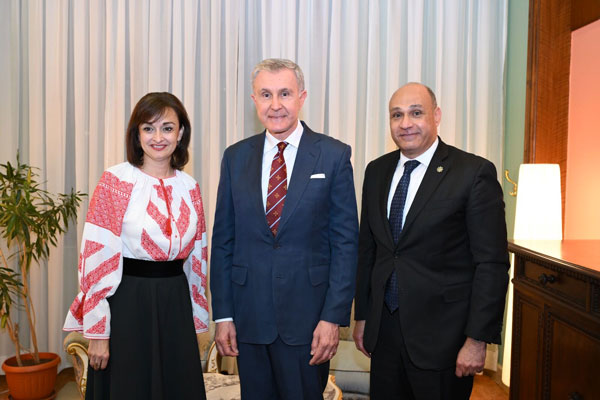 In a landmark visit marking two decades since his last journey to the banks of the Nile, His Royal Highness Prince Radu of Romania sat down with Ahram Online to reflect on a century of enduring friendship between Cairo and Bucharest. As Romania celebrates 120 years of formal diplomatic ties with Egypt, the Prince’s presence serves as a bridge between a storied past—headlined by the iconic 1930 voyage of Queen Marie—and a future defined by mutual stability and strategic cooperation. Through the lens of “royal diplomacy”, the Prince explores how the Crown continues to act as a moral and cultural ambassador in an increasingly complex global landscape. Throughout the exclusive interview, Prince Radu delves into the burgeoning academic and cultural exchanges that underpin modern Romanian-Egyptian relations. From opening new educational initiatives at the British University to praising Egypt’s rapid infrastructural transformation, His Royal Highness provides an intimate look at the role of tradition in fostering innovation. By emphasizing the shared values of multiculturalism and dialogue, he outlines a vision where both nations serve as essential pillars of stability in their respective regions—South-Eastern Europe and the Middle East. Ahram Online (AO): Queen Marie of Romania’s 1930 voyage to Egypt is remembered as a milestone in Romanian Egyptian cultural ties. From your perspective, what role did that visit play in shaping relations between our two nations, and are there lessons from Queen Marie’s approach to “royal diplomacy” that remain relevant today? Prince Radu: Queen Marie’s visit came as a natural consequence of Romania’s opening to the world, starting in 1866. Under the reign of the leader who laid the foundations of the modern Romanian state, King Carol I, Romania established diplomatic relations with important countries of the world, among which was Egypt (in 1906). In 1920, Queen Marie’s son, the future King Carol II, visited Cairo and Luxor and spent several weeks in your country. He brought a message of co-operation and good understanding from his father, King Ferdinand, to the Egyptian authorities. Queen Marie was a leader much loved and respected by Romanians. She promoted our country’s ties with Europe, Africa, and America, built bridges between religions and cultures, being an accomplished diplomat, an author and speaker of several foreign languages. She was the first woman ever to be elected as a member of the French Academy of Arts. Her visit to Egypt remained, over the decades, a reference point in the ties between Cairo and Bucharest. AO: Your Royal House actively promotes culture and education. How can contemporary cooperation in arts, heritage preservation, and academic exchange between Romania and Egypt strengthen our bilateral relations, and are there specific projects you would like to see initiated following your visit? Prince Radu: The ties between Egypt and Romania in the fields of culture, heritage and education are greatly favored by the solidity of our bilateral relations. It is with much pride that we celebrate 120 years since the establishment of diplomatic relations between the Arab Republic of Egypt and Romania. It is one of the oldest and most enduring bilateral relations in the region, forged in a difficult time of history, at the beginning of the 20th Century. Both countries represent today a pole of stability, Egypt in Northern Africa and the Middle East, and Romania in South-Eastern Europe. Both countries play an important role in the Mediterranean dialogue. Our countries have a history built on multi-culturalism, dialogue between religions, receiving, over the centuries, in their culture and traditions, invaluable influences from various great civilizations of the world. Our countries cultivate dialogue, stability and security, economic and military co-operation, multilateral diplomacy, as well as a solid tradition in education and social projects. We already have a close collaboration in higher education, and my visit will seek to deepen the ties between our universities, both those in Bucharest and Cairo, as well as those in important cities in the two countries. I was very happy to open the British University run for the youth employment, as a Sustainable Development Goal (SDG), a symbol of support for empowering young generations in Egypt and around the world. I will also meet the Egyptian Minister of Higher Education, together with the President of the Council of Romanian Universities, professor Sorin Cimpeanu, to express my support in educational projects on our bilateral agenda. Recently, Romania was the Guest of honour at the Cairo International Book Fair, a valuable event with great international impact. In this context, universities in our countries had the opportunity for fruitful meetings. Last, but not least, being a country of the European Union (EU), Romania can increase the exchanges of students, professors, projects and workshops, to support the educational partnership between Egypt and the EU, through programs such as Erasmus mundi and Horizon plus. There is also great potential for deepening bilateral ties in the preservation and development of cultural heritage and museum management. Culture and education are also fundamental for broadening of the chances of the young generation. The youth nowadays bear greater responsibilities than they had in my generation, as they live in more complex and more unpredictable times. It is, therefore, important that, in everything we do, we offer the youth the foundation on which to build their future. AO: During your current visit to Egypt, you have had the opportunity to observe several of the country’s mega national projects. What is your impression of these developments? Prince Radu: For sure, my visit in 2026 is much different than the one I undertook 20 years ago, due to the enormous changes that have occurred in Egypt in the last two decades. Your country has made extraordinary progress in the road, port, and airport infrastructure, it has developed new, ultra-modern urban centers, at an unimaginably fast pace, and has nowadays tourist resorts of the highest quality of hospitality, where we find hundreds of thousands of Romanian tourists per year. AO: How do you assess the state of Romanian Egyptian political and diplomatic relations today, especially considering recent high-level exchanges and growing cooperation within EU and other multilateral frameworks? Prince Radu: I think our countries have today an exemplary bilateral relation, based on trust, respect and a long-lasting partnership. And both our countries are very active and efficient in multi-lateral diplomacy. This is a very solid base for future co-operation, bringing stability and consolidation in our part of the world, on multiple levels. AO: How can “royal diplomacy”—with its emphasis on dialogue, tradition, and moral authority—support efforts to promote stability and peace in the Middle East? Do you see a complementary role for Egypt and Romania in this regard? Prince Radu: The Royal Family of Romania has been, for four generations, a promoter of relations between Cairo and Bucharest. King Carol I, Queen Marie, King Carol II and, later, our generation have, one after another, contributed to the continuity of the 120 years of friendship and co-operation. The Crown represents in Romania continuity and constant attachment to values and principles, so Her Majesty Margareta, Custodian of the Romanian Crown, and I have had the chance to be present, for the last three decades, in several countries in the Middle East, consolidating and sometimes initiating, year after year, different projects. The Royal House of Romania works closely with non-government organization (NGOs) and civic organizations. From your experience, what role can Egyptian and Romanian civil society play in building lasting bridges between our countries beyond traditional government diplomacy? The role of civil society is essential. Egypt has a vocation for multi-culturalism and inter-religious dialogue, not only through its formidable history, carved in a multitude of civilizations and cultures, but also through its geographical position, at an intersection of worlds, philosophies, ways of life and spiritual aspirations. In addition, science and education have, in your country, one of the longest history in the entire world, remarkable personalities and a vast institutional infrastructure. All these are the premises for an active and valuable civil society, with means and the opportunity to consolidate and diversify Egypt’s ties with Romania, and with the other European countries. Egypt has academic, cultural, scientific, and religious personalities who enjoy great respect in Europe and the world and who bring, through their presence and activity, an extraordinary benefit to your country and the Middle East. |



Pentru a putea trimite un comentariu, trebuie sa bifați "Am citit și sunt de acord cu Politica de confidențialitate"